How Smart Marketers Use ChatGPT in 2026 Without Sounding Like a Robot
The dividing line is not talent or prompts. It is knowing which 20 percent of the writing process should never be handed to AI.
You can spot AI written marketing from across the room now. The rhythm is too even. Every sentence is medium length. Everything is “elevating” or “unlocking” something. Readers developed the radar, and content that trips it quietly dies.
Here’s what’s interesting though. The marketers producing the most content in 2026 are also using AI the most heavily, and their stuff doesn’t trip the radar. After months of studying how (and rebuilding my own process around it), the answer is almost annoyingly simple: they split the work differently. AI gets specific jobs. Humans keep specific jobs. The line never moves.
This is where that line sits.
What AI Should Draft
Give AI the structural work: first drafts from a detailed brief, outlines, variations of a headline you already wrote, shortening, expanding, reformatting one piece for another platform. This is 80 percent of writing time and roughly zero percent of what makes writing feel human.
The rule that changed my output: AI drafts from my raw material, never from nothing. I voice note my actual opinion for two minutes, get it transcribed, and hand that to ChatGPT with the brief. The draft comes back sounding like a tidier me, because the thinking was mine. Ask AI to invent the opinion too, and you get the same beige take everyone else’s AI generated that morning.
What Humans Must Keep
Four things never get delegated. The opinion (what do I think that others don’t). The opening line, because hooks live or die on surprise and AI averages toward the expected. The specific details: your real numbers, your client stories, the thing that happened Tuesday. And the final pass, where you read it aloud and rewrite anything you’d never say.
That last one is the cheapest quality control in existence. If your mouth stumbles on a sentence, your reader’s brain did too.
Build a Voice Document Once
The single highest ROI hour of my year: writing a one page tone of voice document. Three examples of my writing, ten words I overuse (kept on purpose), fifteen words I never use, notes on rhythm (“short punchy openers, one liner paragraphs allowed”).
Paste it at the start of any drafting session and the robot accent mostly disappears. Without it, you’re asking AI to guess your voice, and it guesses “LinkedIn, 2023.”
The Banned Words List
Every AI tool has default vocabulary, and readers have learned it. My banned list lives in the voice document: elevate, unlock, seamless, game changer, dive in, revolutionize, empower, “in today’s fast paced world.”
None of these words are wrong. They’re worn out. They signal “no human chose this word,” and one of them in a headline can cost you the click. Tell your AI tool the list once per session and it obeys surprisingly well.
Build your own list by rereading your last month of AI assisted posts and highlighting every phrase you’d never say across a coffee table. Ten minutes, one afternoon. The list you make from your own drafts will protect your voice better than any generic one, including mine.
A Before and After, So You Can See the Line
Here’s what the split looks like in practice. The AI first draft of a launch email opened with: “We’re thrilled to announce an exciting new way to streamline your workflow and unlock productivity.”
Twenty words, zero information, four banned list entries. Nobody’s fault. That’s what “write a launch email” produces without raw material.
The published version, after the human pass: “Last month, three of you emailed me the same complaint about invoicing. This fixes it.” Same product, same email, but now it opens with a real observation only I could make, and the reader knows within two sentences whether this concerns them.
The AI still wrote most of that email. The middle paragraphs, the feature summary, the formatting, all AI drafted from my brief, all perfectly good. The 20 percent I rewrote is the 20 percent readers actually judge. That’s the whole division of labour in one example.
Is It Still Authentic if AI Drafted It?
Fair question, and it deserves a real answer. My take: authenticity lives in the opinion, the experience, and the accountability, not in which fingers typed the words. Marketers have used editors, ghostwriters, and templates forever.
Where it tips into fake: publishing AI’s opinions as yours, inventing experiences you didn’t have, or shipping drafts you never read. The radar catches that eventually. It always does.
The Workflow, Start to Finish
Mine, for one article: voice note the opinion (2 minutes), transcribe and brief ChatGPT with the voice document attached (5 minutes), get the draft, rewrite the hook by hand, insert real numbers and one real story, read aloud, cut ten percent, publish. About 45 minutes for what used to take three hours.
Your 15 Minute Setup Checklist
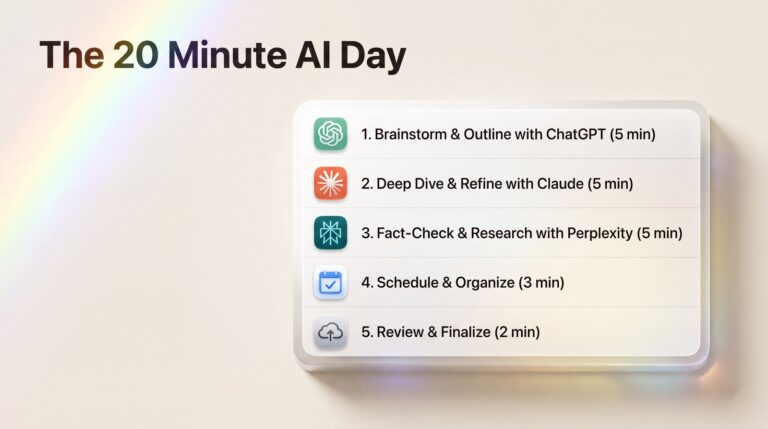
Everything above compresses into one setup session. Five minutes: create the voice document with three writing samples and your banned words list. Five minutes: write your standard drafting brief template (audience, goal, three points, attach voice doc). Five minutes: record your first two minute voice note opinion on whatever you’re publishing next.
That’s the whole system installed. The first article you run through it will feel clunky. The third will feel obvious. Somewhere around the tenth, you’ll read a competitor’s clearly unedited AI post and physically wince, which is how you’ll know your radar (and your standards) moved.
Try one piece this way tomorrow. Voice note first, AI second, your hands on the hook. That order is the entire trick.
Want the drafting prompts that go with this workflow? My free 100 AI Prompts pack covers briefs, rewrites, and repurposing, ready to paste. Get it free.